By now, you may have already heard iFIT Trainers mention RPE during running or biking workouts. What does RPE really mean, and how can you use it as a tool during your workout? Luckily, it’s relatively easy to nail down RPE and learn how to gauge how you’re feeling based on that scale.
Rate of Perceived Exertion, or RPE, is a numeric method of measuring your activity intensity level. Using a zero to 10 scale, RPE is entirely subjective and based on variables that change on a day-to-day basis. iFIT Trainers use RPE to help you try to put in the right amount of effort without shortchanging or overexerting yourself. Read on for more about RPE.
The origin of RPE
During the 1960s and 1970s, Swedish scientist Gunnar Borg pioneered the Rating of Perceived Exertion Scale. Borg’s 6-20 scale was designed to correspond directly with heart rates from 60 beats per minute (bpm) to 200 bpm.
At the lowest point on the RPE scale, a rating of six indicated “no exertion at all,” whereas a rating of 20 indicated “maximal exertion.” To use this scale, participants would rate their exertion level and then ramp up or slow their workout or movement. For example, during a quick power-walking session, your RPE could be a 12 on the Borg Scale. According to the above, you can determine your heart rate during this activity by multiplying 12 by 10 for a heart rate of 120 bpm. This scale became incredibly popular as it served as an effective method of gauging heart rate during physical activity. Remember, this was long before heart rate monitors!
In 1986, Borg’s RPE scale was included as a “guide in monitoring and regulating exercise intensity” in the ACSM Guidelines for Exercise Testing and Prescription.
RPE today
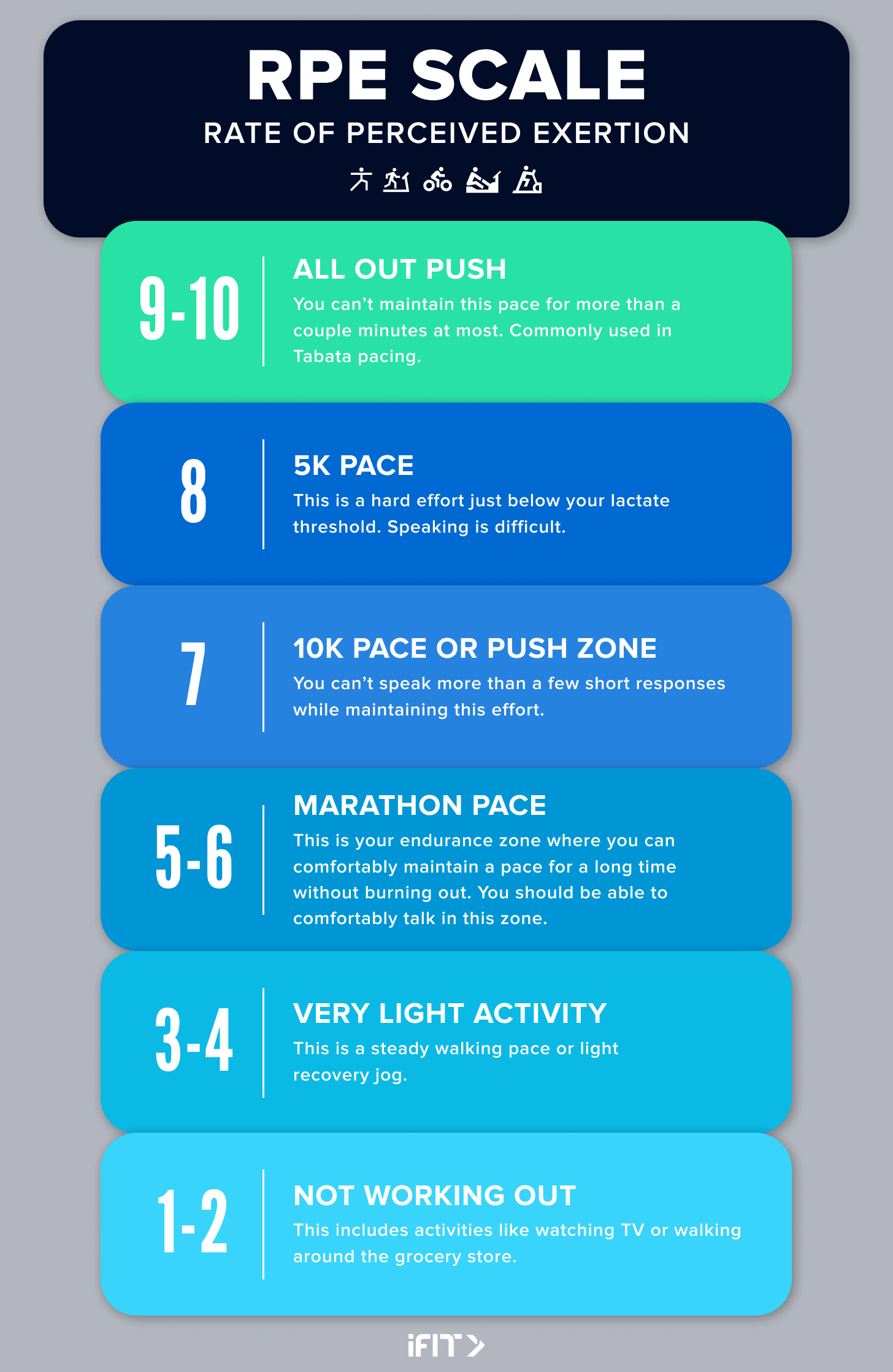
Though Borg’s original RPE scale was incredibly useful in the late 20th century, it was modified as heart rate technology progressed. While the original Borg scale is used, more people gravitate toward a revised Borg scale called the Borg-Category-Ratio scale (CR10). This is what we use here at iFIT!
This scale is rated from zero to 10, with zero being “no effort” and 10 described as “maximum effort.” With this new scale, there is no heart rate math; it's entirely focused on perceived exertion, so it’s more simplistic. One of the great things about this scale is that it is dependent upon the individual. What feels like a four one day might feel like a seven another day, despite being the same exercise or movement. This is because factors such as sleep, hydration, stress, diet, injury, and more affect athletic performance. Maybe one day, you felt fantastic and had a great workout because of it. On another day, you didn’t have much water to drink, or you pulled a muscle the day before. Even if they may seem like minor issues, these variables can significantly impact your performance.
The revised CR scale allows you to stay within the bounds of moderate-intensity exercise without pushing yourself too hard. While you surely wish to give it your all, you also want to stay within a prescribed RPE when an iFIT Trainer calls out a four or five on the scale. To get the most out of your workout, you need to practice self-awareness here. How do you feel overall? What was your diet like before working out today? Did you sleep well? Questions like these are essential, as they’ll help you gauge where you fall on the RPE scale.
Another crucial aspect of RPE training is to be honest with yourself. If an exercise feels like an eight, don’t try to downplay how your body feels and call it a four. This could potentially lead to overexertion in the form of a strained muscle or other injuries. Instead, keep track of your RPE during every workout so that you can see linear progress. As you continue to put in the work, your RPE will show how far you’ve come!
Disclaimer: This blog post is not intended to replace the advice of a medical professional. The above information should not be used to diagnose, treat, or prevent any disease or medical condition. Please consult your doctor before making any changes to your diet, sleep methods, daily activity, or fitness routine. iFIT assumes no responsibility for any personal injury or damage sustained by any recommendations, opinions, or advice given in this article. Always follow the safety precautions included in the owner’s manual of your fitness equipment.
You might also like

Explore the Equator in the Trip to the Tropics Challenge
Ready to heat things up? This month’s Challenge takes you on a sun-soaked journey between the Tropic of Cancer and the Tropic of Capricorn. In the Trip to the Tropics Challenge, vibrant landscapes meet energizing workouts infused with adventure. Each workout is set between the two iconic latitude lines that frame the tropical belt. These regions are known for dramatic coastlines, lush rainforests, high-altitude peaks, and sunny beaches. From Hawaii and Costa Rica to St. Lucia and French Polynesia, there’s so much to explore and experience in June! Complete the workouts from your selected Challenge level by June 30, 2025 and you’ll earn this digital reward for your Trophy Case. Here are this month’s Challenges: Treadmill and elliptical workouts Walking: Lace up your shoes for an epic adventure to Costa Rica, St. Lucia, and Martinique. You’ll feel the heat as you move with iFIT Trainers John Peel, Chris Clark, Stacie Clark, and Alex Gregory. Join the Trip to the Tropics Challenge: Walking Running: Focus on intervals, endurance, and tempo as you explore stunning Costa Rica, Puerto Rico, and French Polynesia. Soak in the sun and encouragement alongside iFIT Trainers Knox Robinson, Hannah Eden, Paulo Barreto, and Leah Rosenfeld. Join the Trip to the Tropics Challenge: Running Bike workouts Casual Riding: Clip in and get ready to ride in the lush backdrop of Hawaii, Bermuda, and Costa Rica. Join iFIT Trainers George Hincapie, Gideon Akande, and John Peel for endless adventure in the sun. Join the Trip to the Tropics Challenge: Casual Riding Amped Cycling: Kick things up a notch in Thailand, Hawaii, and Vietnam as you improve your fitness. Soak in the sights and sounds as you ride alongside iFIT Trainers Richard Biglia, George Hincapie, and Casey Zaugg. Join the Trip to the Tropics Challenge: Amped Cycling Rower workouts Rowing: Explore the crystal clear waters of Martinique, Hawaii, and French Polynesia as you row. Paddle your way through the beauty of these countries with iFIT Trainers Alex Gregory, Kai Wilding, and Kevin Scott. Join the Trip to the Tropics Challenge: Rowing Strength workouts Strength: Find strength and beauty in strength and yoga workouts set in Vietnam, Jamaica, and Thailand. Soak it all in as you challenge your body with iFIT Trainers Hannah Eden, Aaron Ross, and Briohny Smyth. Join the Trip to the Tropics Challenge: Strength Disclaimer: The primary purpose of this blog post is to inform and entertain. Nothing on the post constitutes or is intended to be a substitute for professional medical advice, prevention, diagnosis, or treatment. Reliance on any information provided on the blog is solely at your own risk. Always seek the advice of your physician or other qualified health provider with any questions you may have regarding a medical condition, and please consult your doctor or other health care provider before making any changes to your diet, sleep methods, daily activity, or fitness routine. Do not disregard professional medical advice or delay seeking it because of information available on this blog. iFIT assumes no responsibility for any personal injury or damage sustained by any recommendations, opinions, or advice given in this article. Always follow the safety precautions included in the owner’s manual of your fitness equipment.
June 2, 2025

Push Your Limits as You Shine Bright in the Grit & Glow Challenge
Ready to sparkle like a diamond as you tackle April’s Challenge? As a nod to this month’s birthstone, we have workouts sure to make you feel shiny and bright while you sweat! Complete the workouts from your selected Challenge level by April 30, 2025 and earn a digital reward viewable in your Trophy Case. Here are this month’s Challenges: Treadmill and elliptical workouts Walking: From the Dominican Republic to Zimbabwe and Canada, there’s so much to explore this month. You’re sure to shine as you walk and hike with iFIT Trainers Phil Catudal, Mick Davie, and John Peel. Running: Start your running adventure in French Polynesia, the Balkans, and New Zealand. You’ll sparkle alongside iFIT Trainers Hannah Eden, Paulo Barreto, Kelsey Sheahan, and Zac Marion. Bike workouts Casual Riding: Embark on an exploration in Chile, Maui, and French Polynesia. Chase your shine with iFIT Trainers John Peel, Ashley McIvor, and Ashley Davis with beginner-level cycling workouts. Amped Cycling: Take it to the next level with iFIT Trainers Richard Biglia, Travis McCabe, and Casey Zaugg! Feel bright and shiny as you tackle advanced cycling workouts in Thailand, Japan, and Norway. Rower workouts Rowing: Row your way across Hawaii, Montana, and the iFIT Studio! Sparkle and shine in each of these workouts with iFIT Trainers Kai Wilding, Susan Francia, and Alex Silver-Fagan. Strength workouts Strength: From Pilates and yoga to traditional strength training, there’s so much to explore this month. Head to the Bahamas, Chile, and Jamaica for workouts with iFIT Trainers Kelsey Sheahan, Faith Hunter, and John Peel. Disclaimer: The primary purpose of this blog post is to inform and entertain. Nothing on the post constitutes or is intended to be a substitute for professional medical advice, prevention, diagnosis, or treatment. Reliance on any information provided on the blog is solely at your own risk. Always seek the advice of your physician or other qualified health provider with any questions you may have regarding a medical condition, and please consult your doctor or other health care provider before making any changes to your diet, sleep methods, daily activity, or fitness routine. Do not disregard professional medical advice or delay seeking it because of information available on this blog. iFIT assumes no responsibility for any personal injury or damage sustained by any recommendations, opinions, or advice given in this article. Always follow the safety precautions included in the owner’s manual of your fitness equipment.
April 1, 2025
How to Bring Your A-Game to the Train for a Tour Series (Part 1/3)
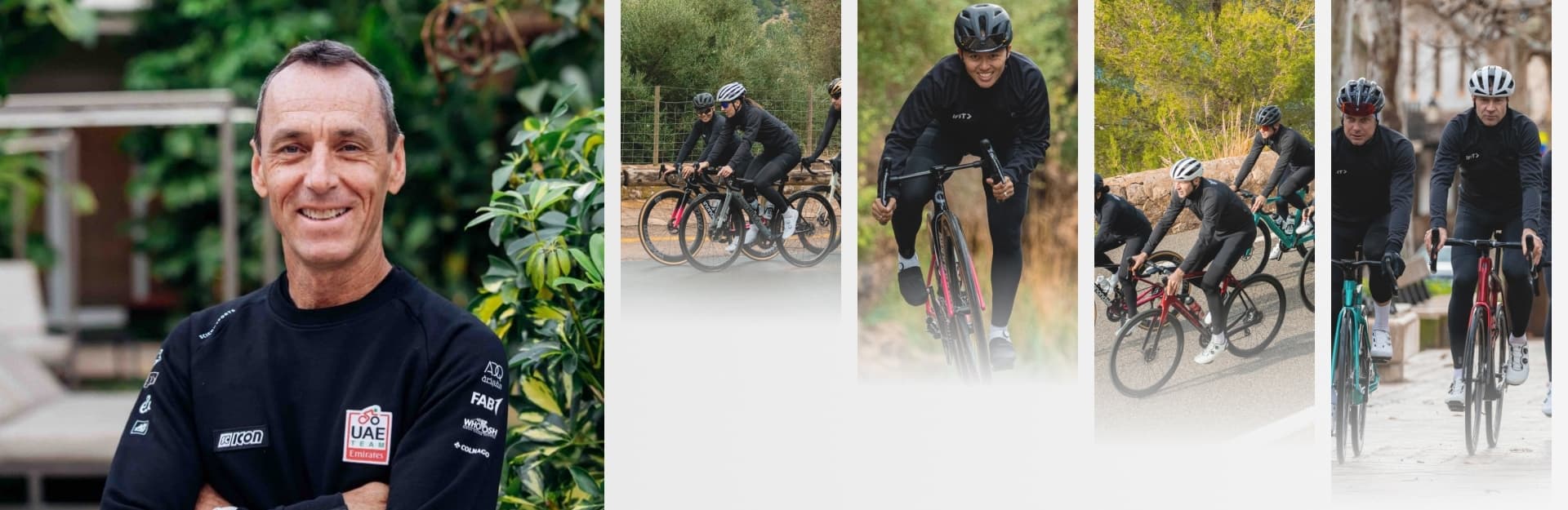
If you’re familiar with the cycling world and follow European racing, you may have come across both myself and the team I coach, the UAE Team Emirates. I’m Kevin Poulton and have coached for nearly 25 years, specializing in Spring Classics riders and sprinters. In that time, I’ve been fortunate to coach elite World Tour professionals and work with some of the best teams in the sport. My athletes have secured victories in Paris-Roubaix, Tour de France stage wins, World Championship Road Race podiums, and multiple Spring Classics podiums. And now, you’re my next athlete! The Series Structure I designed the Train for a Tour Series much like the programs I use at UAE Team Emirates’ training camps. Over six weeks, your iFIT Trainers (all of which are pro cyclists themselves) will run you through an immersive World Tour pre-season experience. You’ll train in Mallorca, Spain, as it is the ultimate training destination for professionals. Every winter, World Tour teams flock to the island for their pre-season camps, and for good reason. The terrain is incredibly diverse, offering long, steady climbs, rolling hills, and flat coastal roads—exactly what’s needed to develop all aspects of cycling fitness. The Train for a Tour Series gradually builds in intensity, taking you from controlled endurance efforts to high-powered, race-specific efforts. The workouts follow a carefully structured progression: Early Weeks: Lower-intensity, steady-state efforts with proper recovery, laying the foundation for improved aerobic endurance and efficiency.Mid-Series: More focused interval work, targeting different energy systems, including fast-twitch muscle activation, anaerobic power, and high-intensity efforts.Final Weeks: Race-like sessions, including VO2 max intervals, lactate tolerance efforts, and short recoveries, mimicking the demands of competition. If you follow my training program as I’ve laid out (and you ensure that the SmartAdjust™ feature on your bike is on), you can expect to see improvements in your cycling performance, endurance, and ability to sustain high-intensity efforts. Check out more articles on training like the pros:Part 2: leveraging data Part 3: how to avoid beginner mistakes Good luck and enjoy the ride, Kevin Poulton Shop NordicTrack bikes Disclaimer: The primary purpose of this blog post is to inform and entertain. Nothing on the post constitutes or is intended to be a substitute for professional medical advice, prevention, diagnosis, or treatment. Reliance on any information provided on the blog is solely at your own risk. Always seek the advice of your physician or other qualified health provider with any questions you may have regarding a medical condition, and please consult your doctor or other health care provider before making any changes to your diet, sleep methods, daily activity, or fitness routine. Do not disregard professional medical advice or delay seeking it because of information available on this blog. NordicTrack assumes no responsibility for any personal injury or damage sustained by any recommendations, opinions, or advice given in this article. Always follow the safety precautions included in the owner’s manual of your fitness equipment.
March 18, 2025


